
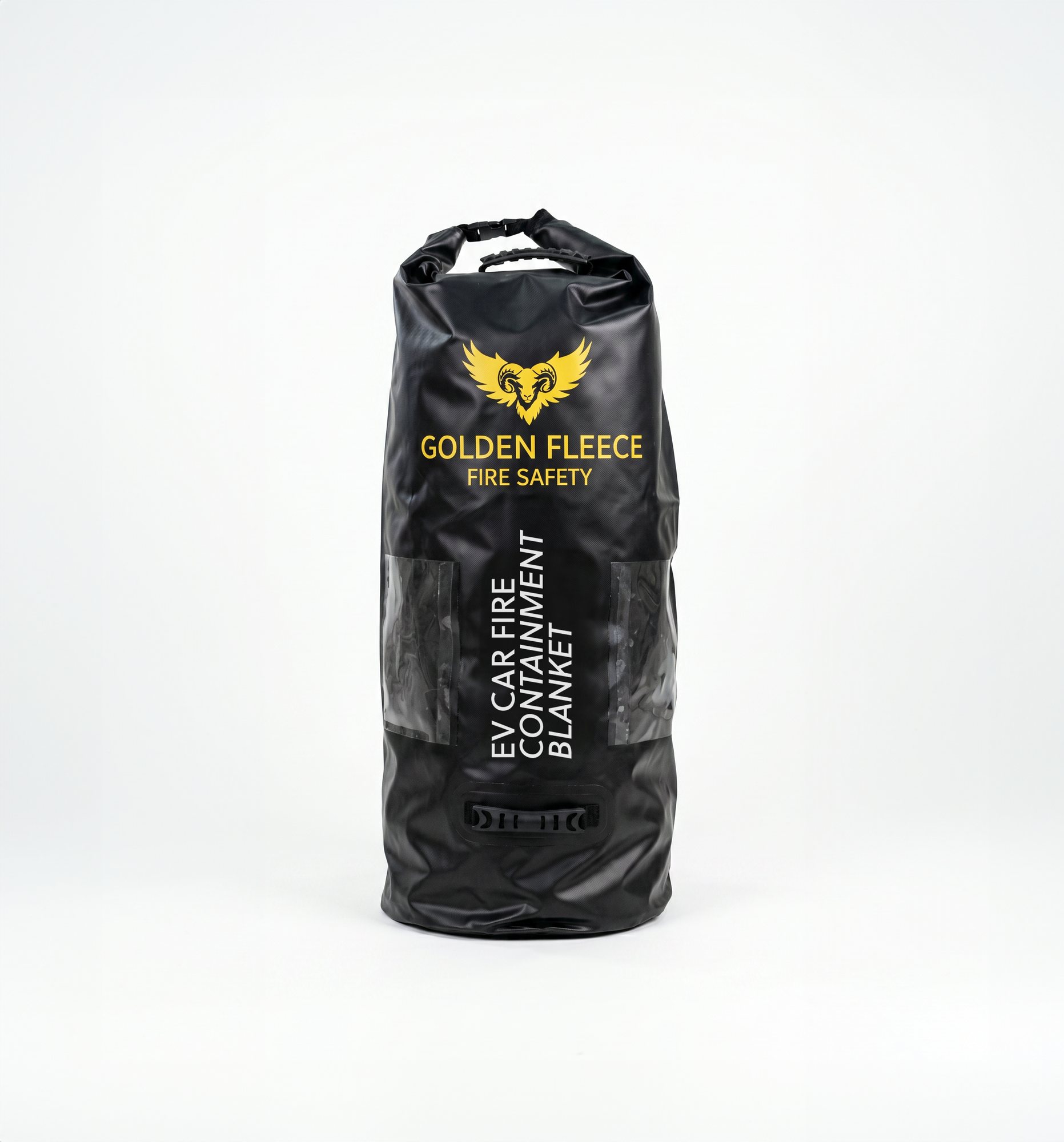
01 — Storage & Transport
Outer Carry Bag
Weather-sealed, branded storage and transport bag. Keeps the blanket protected, identifiable, and ready for rapid deployment from any fixed or mobile response point.
Prevention removes the predictable failures. Containment holds the ones that get through. We stop most of them, and we contain the rest.
Golden Fleece designs and makes certified lithium-ion fire containment — from a wall-mounted unit for a single suspect device to a blanket for a vehicle in full runaway. Engineered by firefighters, independently tested, and backed by an end-to-end response programme with replacement cover.
The lithium-ion traction battery problem is not confined to electric cars. Wherever a traction battery charges — overnight, indoors, alongside stock, alongside personnel — the same chemistry, the same thermal runaway profile, and the same HAZMAT consequences apply.
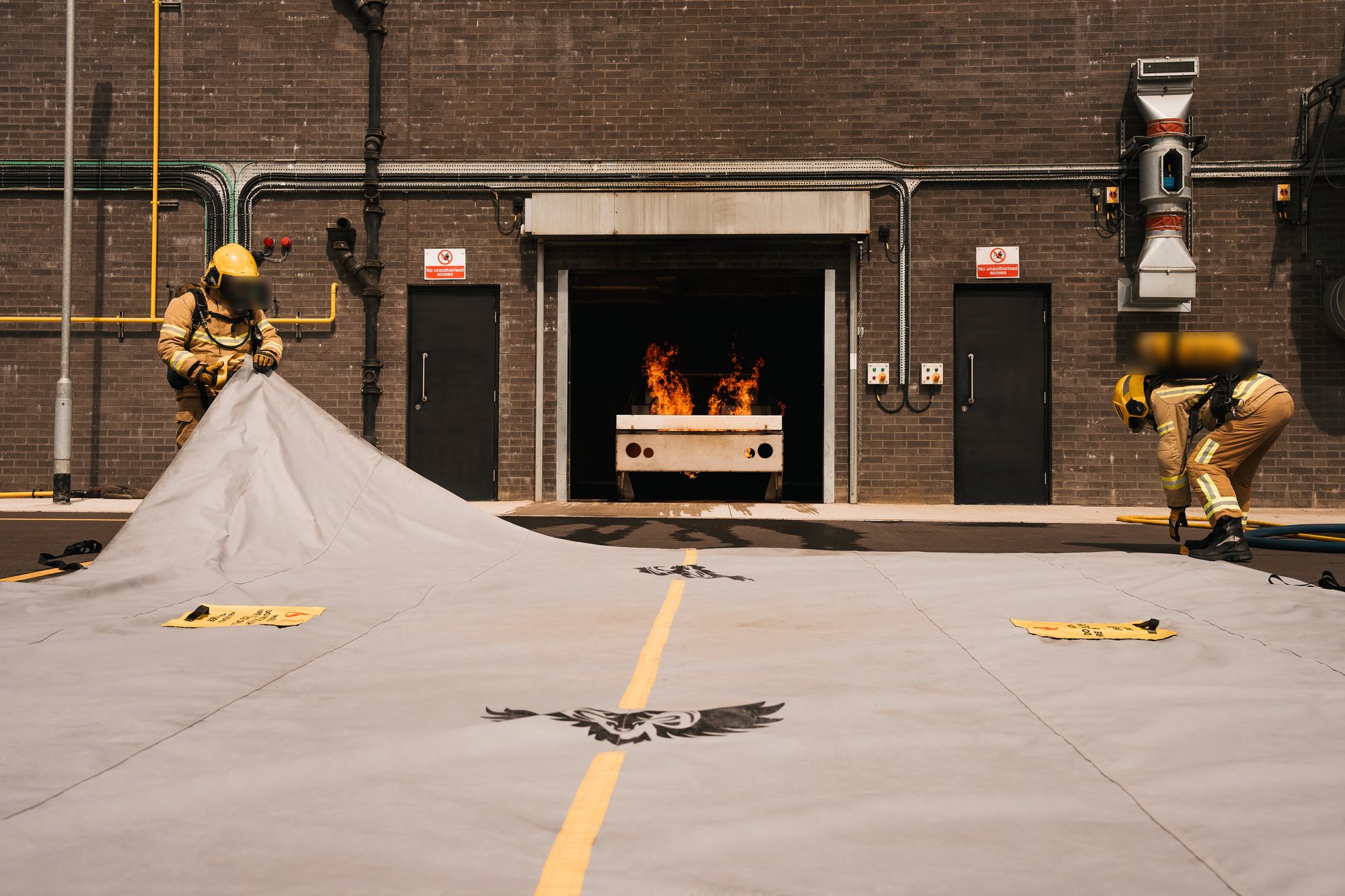
Most operations have thought about the EVs in their staff car park. Far fewer have thought about the lithium-ion forklift fleet sitting on a charger overnight inside the warehouse — or the AGVs, the ride-on scrubbers, the e-bikes for last-mile delivery, the ground-support equipment, the scissor lifts.
Industrial charging areas are typically sanitised. They are kept clear, segregated, and at distance from production. That is sound practice — and it does not stop a single thermal runaway event from turning the surrounding facility into a HAZMAT cleaning problem.
The charging zone contains the start of the incident. It does not contain the consequences.
Lithium-ion thermal runaway is a chemical incident before it is a thermal one. The fire is the visible symptom; the hazardous-materials problem is what lingers — across the site, the workforce, and the infrastructure — long after suppression appears complete.
Burning electrolyte releases hydrofluoric acid and a cocktail of toxic gases — corrosive to skin, lungs, concrete, and steel. Smoke and runoff contaminate well beyond the incident footprint, and the contamination persists long after the fire is out.
Reignition risk persists for up to 72 hours after apparent extinction. Containment, not suppression, is the operating model — and it must continue long after the fire team stands down.
Cell-level temperatures exceed the ignition point of most adjacent materials. Conventional vehicle blankets and dry powder offer no meaningful containment at these temperatures.
An EV in thermal runaway emits a measured cocktail of flammable, asphyxiant, and acutely toxic compounds — carbon monoxide and hydrogen among them, and hydrogen fluoride the one that lingers. Treating the incident as a fire alone misreads it.
| Compound | Class | Hazard |
|---|---|---|
| Carbon monoxide CO | Major | Asphyxiant; abundant by volume |
| Carbon dioxide CO₂ | Major | Suffocation hazard at scale |
| Hydrogen H₂ | Major | Flammable; deferred-ignition explosion risk |
| Hydrocarbons CH₄, C₂H₆… | Major | Flammable; contribute to LFL breach |
| Hydrogen fluoride HF | Toxic | Severe respiratory, skin, infrastructure damage |
| Phosphoryl fluoride POF₃ | Toxic | Highly toxic; produced alongside HF |
| Benzene, toluene, styrene, formaldehyde | Toxic | Carcinogenic and irritant; observed in test fires |
A 70 kWh EV pack in full thermal runaway can release on the order of 1.4 to 14 kilograms of hydrogen fluoride alone.
Researchers measured HF generation between 20 and 200 milligrams per watt-hour of nominal battery capacity across seven commercial cell types. At pack scale, that translates to industrial quantities of an acutely toxic acid gas — sufficient to contaminate enclosed volumes far larger than the incident footprint, persist in runoff and on surfaces, and degrade concrete, steel, and respiratory tissue alike.
NMC cells (the dominant chemistry in battery-electric vehicles) produce larger total off-gas volumes and higher CO emissions, particularly at high state of charge. LFP cells produce less off-gas overall but are more toxic in absolute terms, with proportionally greater HF release and a lower flammability limit. Neither is safe; both demand the same containment discipline.
State of charge compounds the hazard. A fully-charged pack produces dramatically more gas than a depleted one — which is why fleet charging stations, depots, and overnight storage are the highest-exposure environments in any operation.
The "contain the rest" half of the promise — one material, engineered by firefighters and certified to DIN 91489:2024-11, worked three ways: stored at rest, dropped in at the first sign of trouble, or deployed over a vehicle in full thermal runaway.

For the lithium that sits at rest — the overnight charging bank, the battery store, the shelf of spares and returns — a storage container cut from the same certified material as the blanket. It keeps at-risk and suspect items segregated and held, unattended, at the point where they gather.
Made from the same DIN 91489:2024-11-certified containment material as the Golden Fleece blanket.
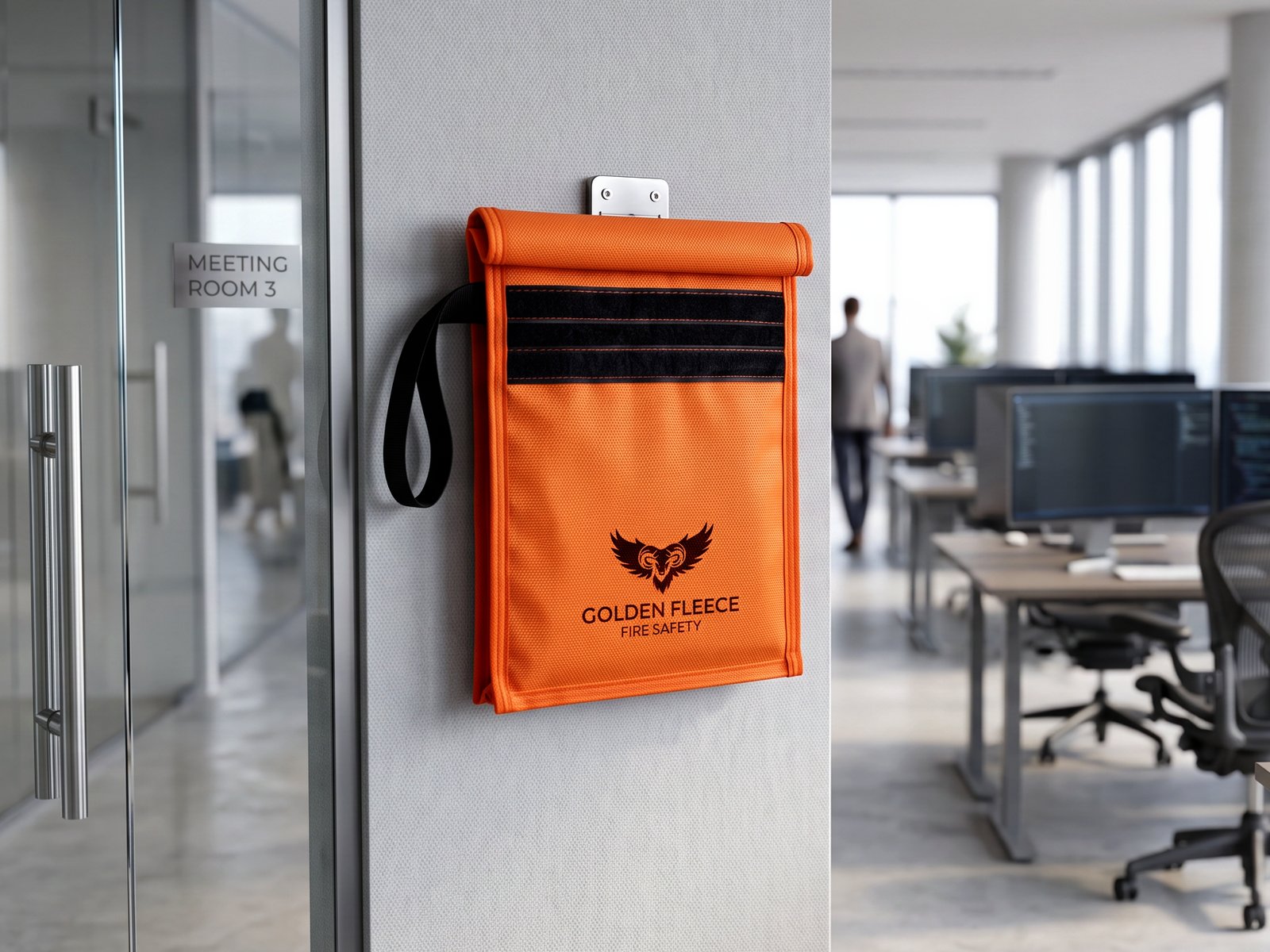
Mounted on the wall on the sharps-bin principle: the moment a device looks wrong — warm, swollen, hissing, or damaged — it goes straight in, out of contact with everything around it. A first-response control any member of staff can use on the spot, wherever a problem is noticed: the office, the workshop, the retail floor, the transport hub.
Made from the same DIN 91489:2024-11-certified containment material as the blanket.
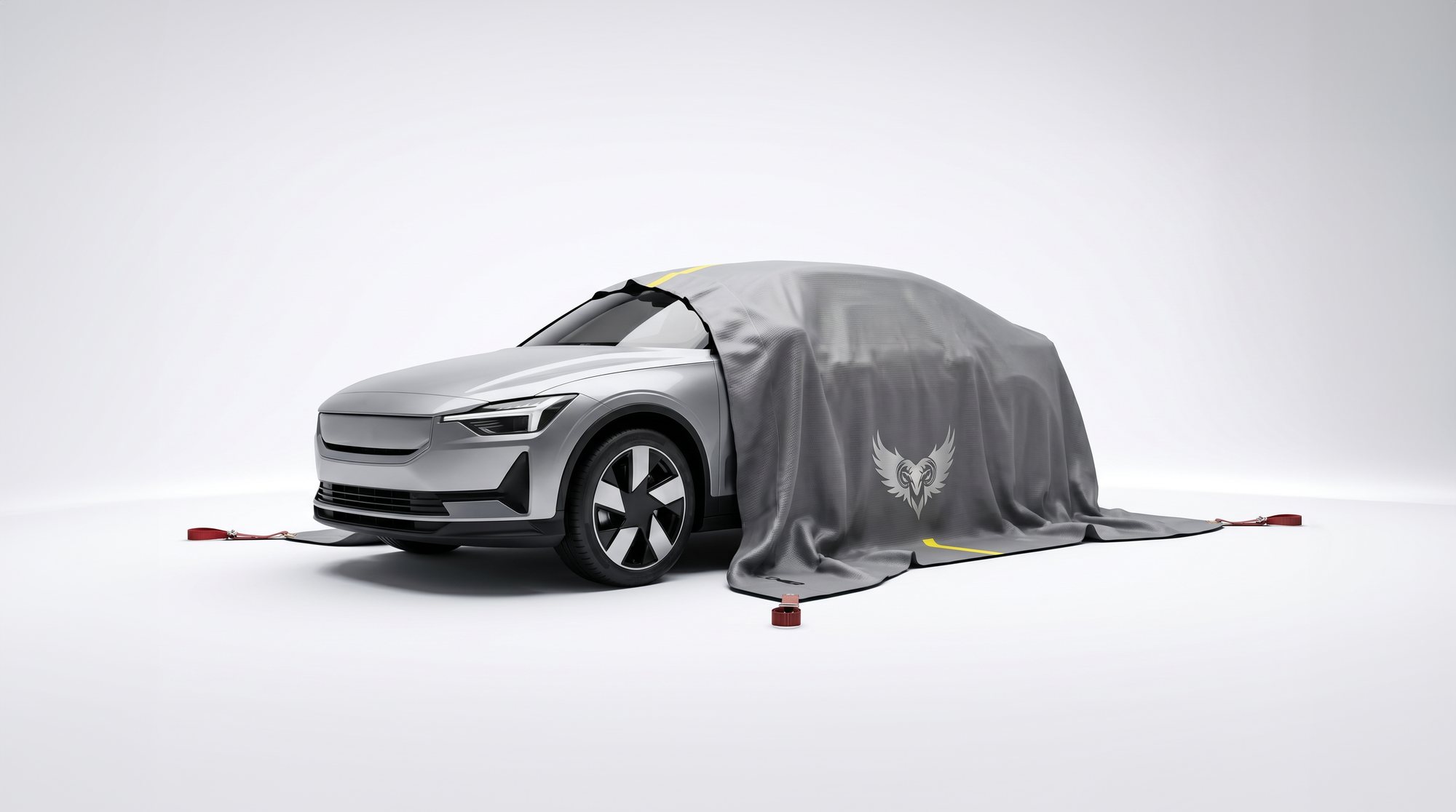
Designed by firefighters, for the incident firefighters actually face. As a professional organisation working to DIN 91489:2024-11, we needed technology to match our standards. The available products didn't. So we built our own.
The Golden Fleece Containment Blanket is certified to DIN 91489:2024-11 and independently audited by SGS. It is engineered the way it is because of the expertise behind it — the standards, the frontline command experience, the independent testing. The product is where that expertise becomes something you can specify and deploy.
The product is the point. The programme is why this one holds up.
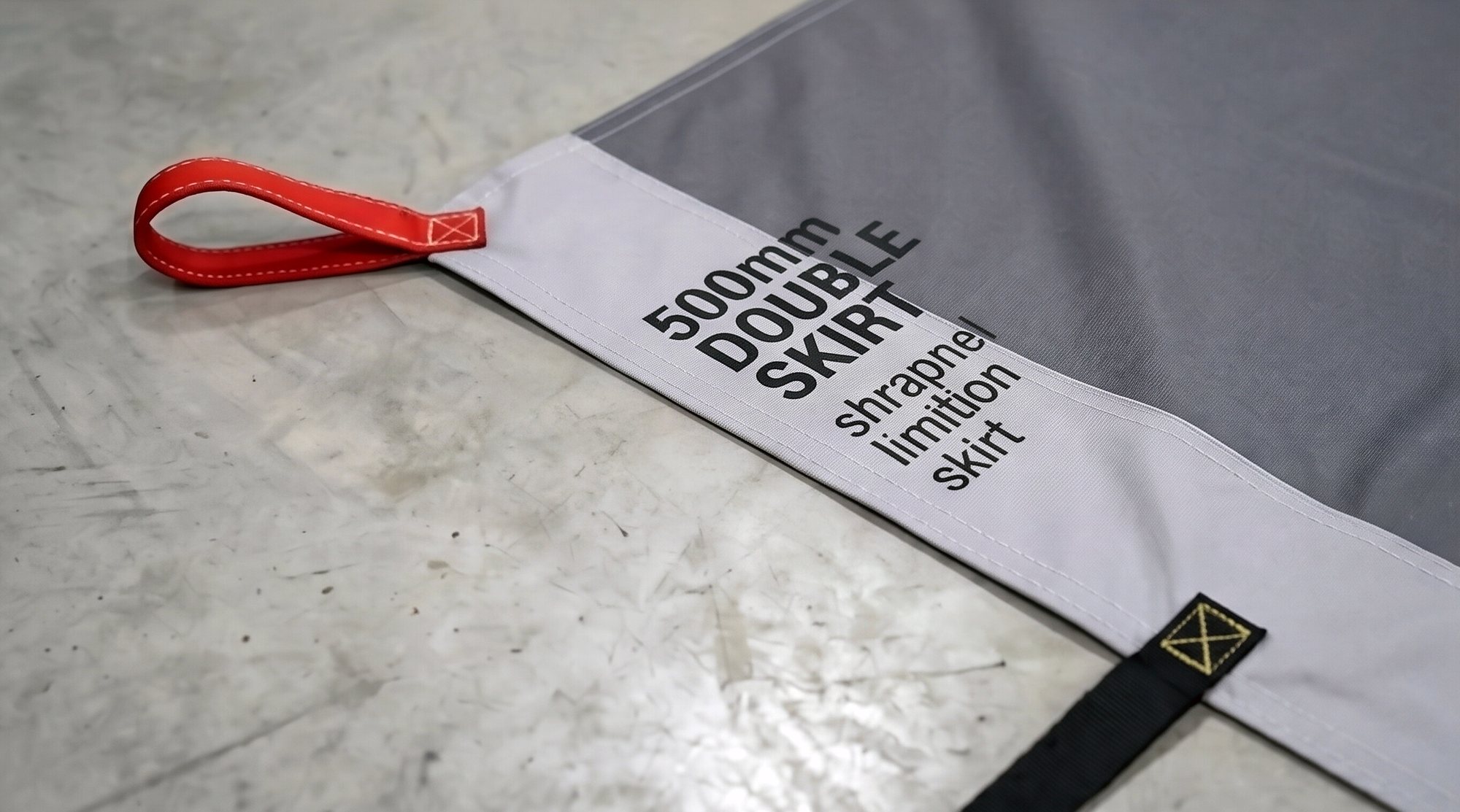
500 mm double skirt. Reinforced lifting loops. Engineered, not assembled.
A shrapnel-limitation skirt runs the full perimeter — designed to contain ejected cell fragments during venting. Red corner loops are sized for gloved hand or hook deployment, with reinforced stitching specified to the standard. Every metric on this blanket is documented and traceable.
The blanket ships as part of a complete response kit. Each component is engineered to a defined stage of the response lifecycle — from rapid deployment through HAZMAT recovery.
Weather-sealed, branded storage and transport bag. Keeps the blanket protected, identifiable, and ready for rapid deployment from any fixed or mobile response point.
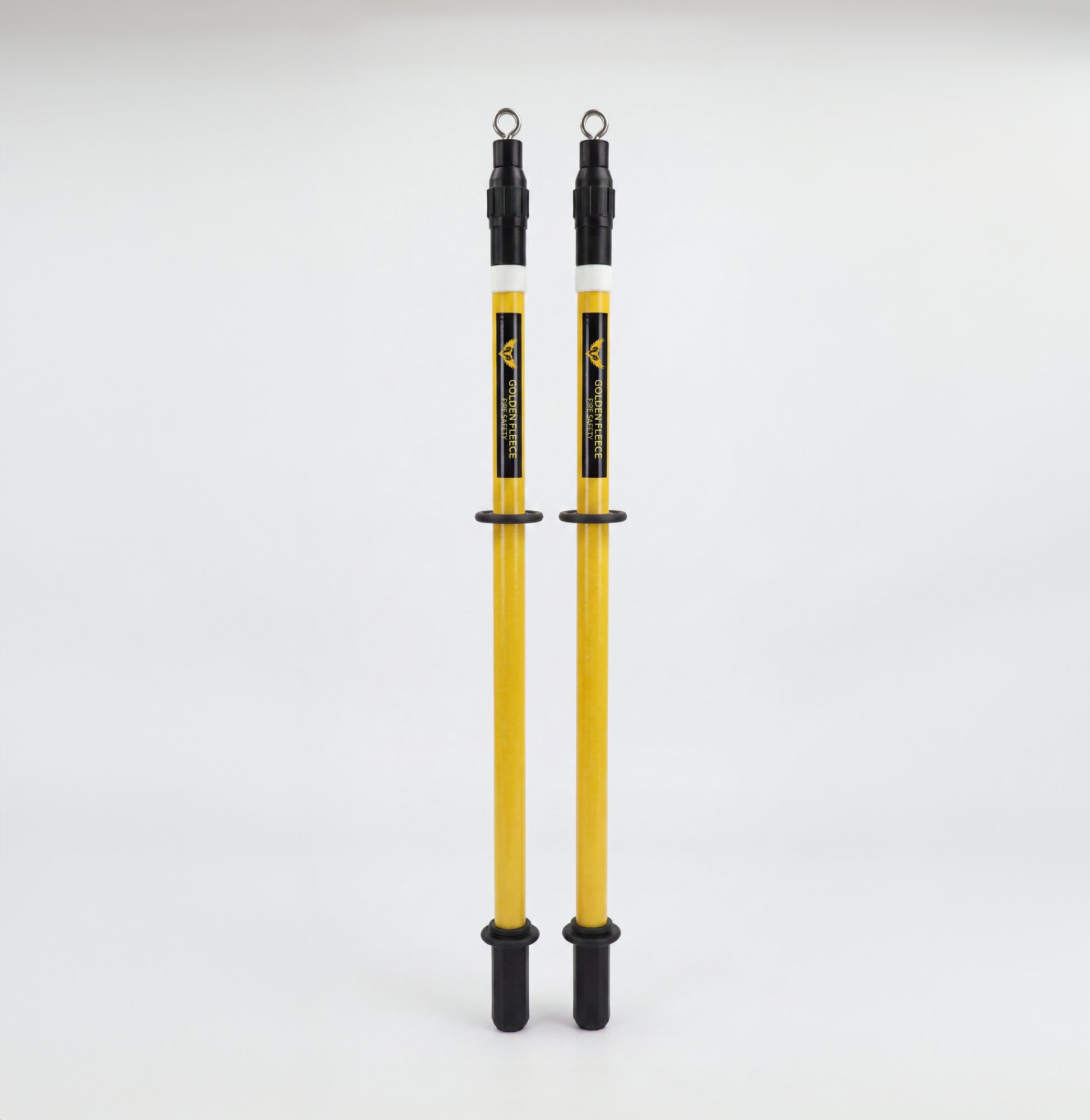
Telescopic deployment poles with hooked ends, used to spread the blanket onto an incident from outside the hazard envelope — without responders entering the thermal-runaway zone.
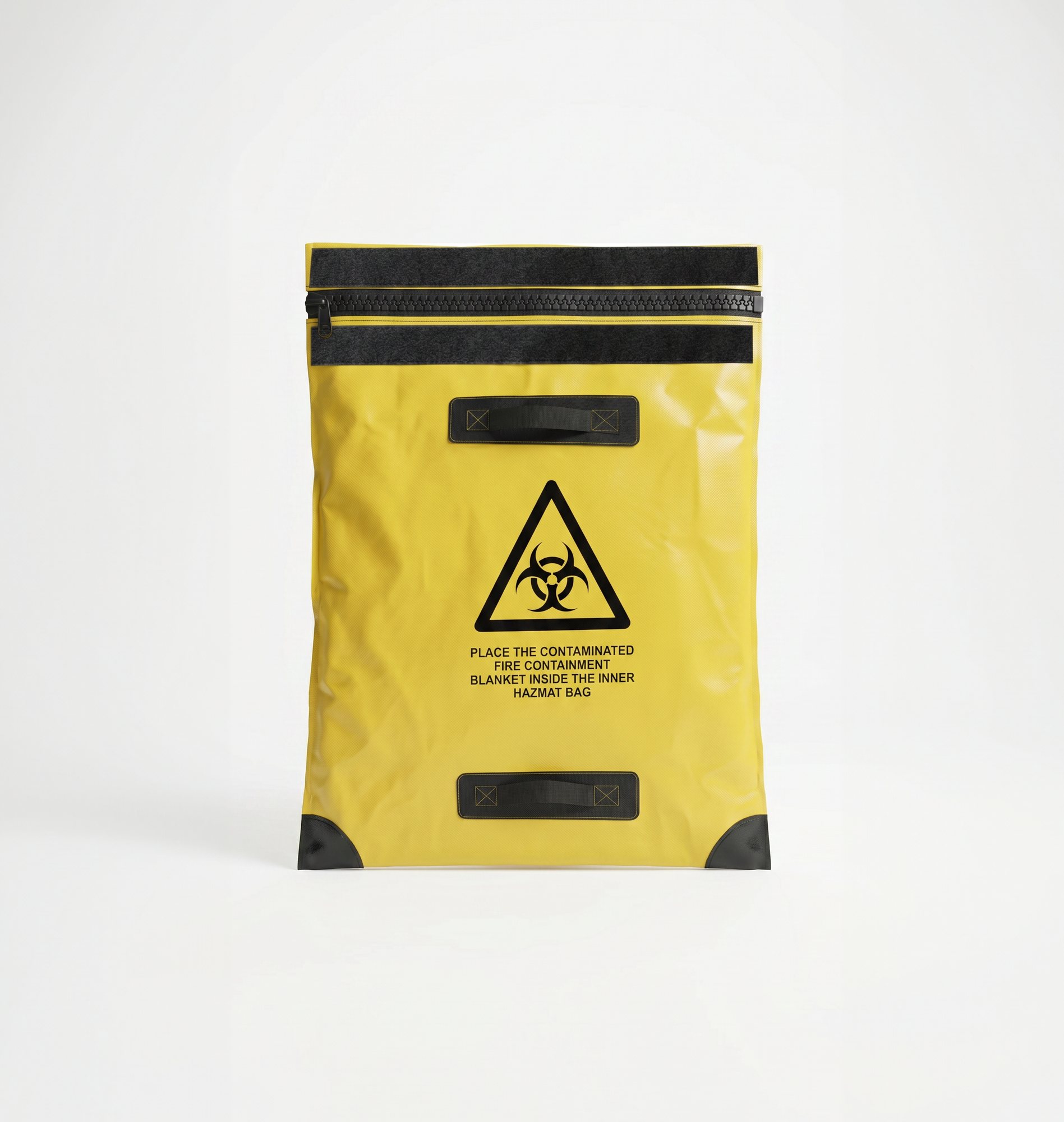
Biohazard-marked containment bag for the contaminated blanket post-incident. Handled to a documented HAZMAT chain-of-custody, preventing secondary contamination of personnel, infrastructure, or waste streams.
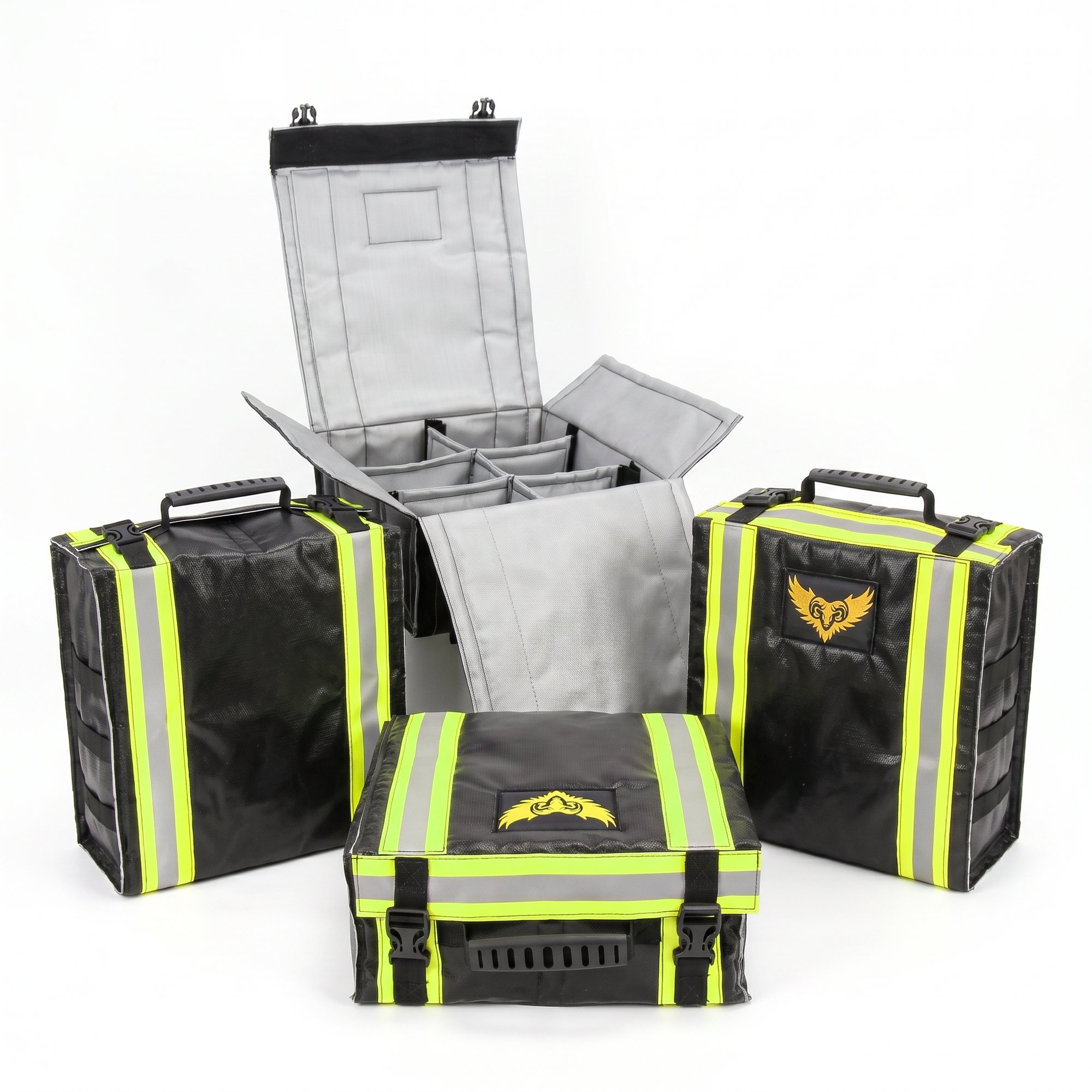
Fire-resistant containment bags for safe transport and storage of lithium-ion batteries.
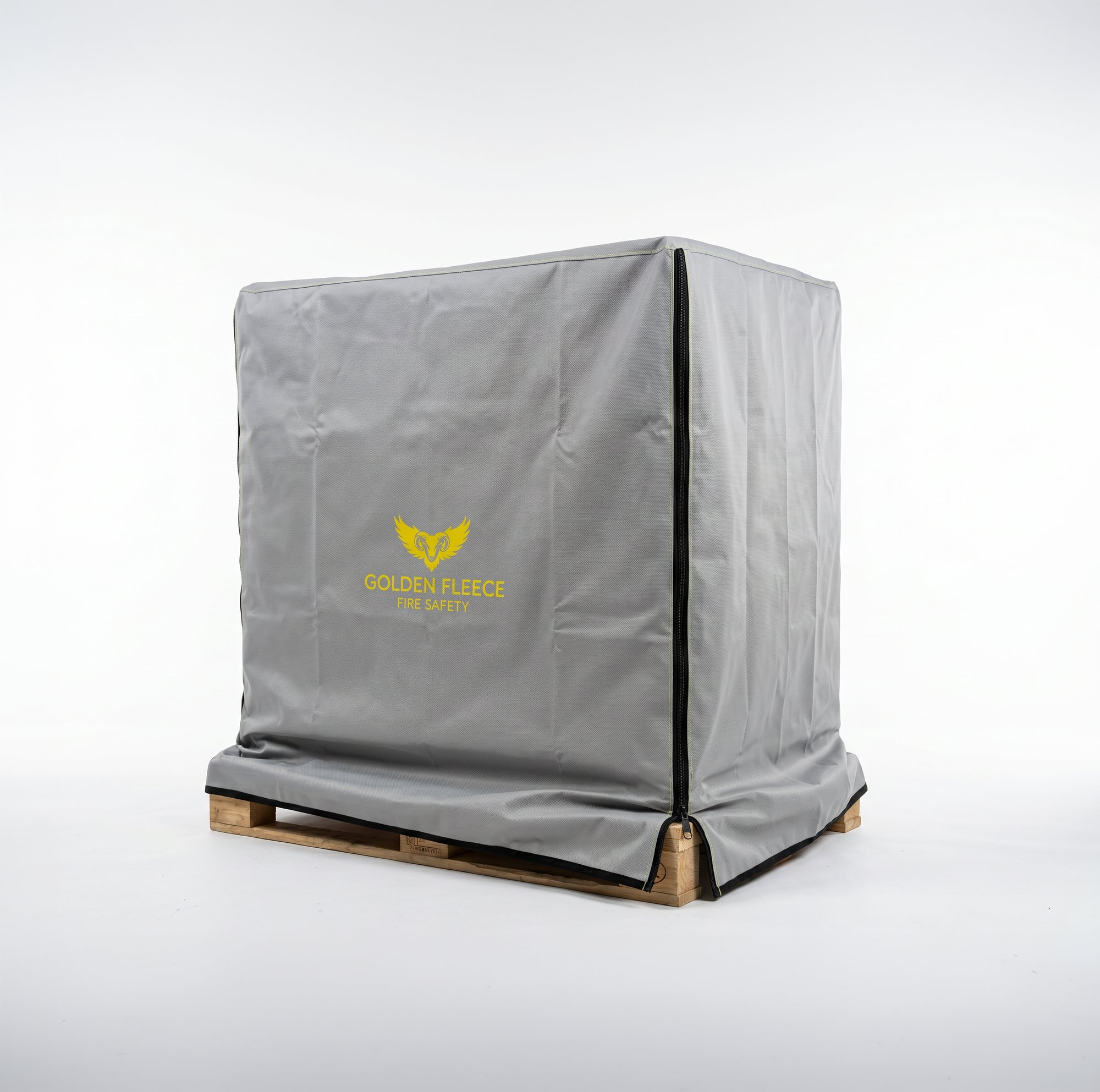
Silicone-coated, fire-resistant cover engineered for palletised lithium-ion goods in storage, charging areas, and transit. Containment at the source — before a damaged cell ever becomes an incident.
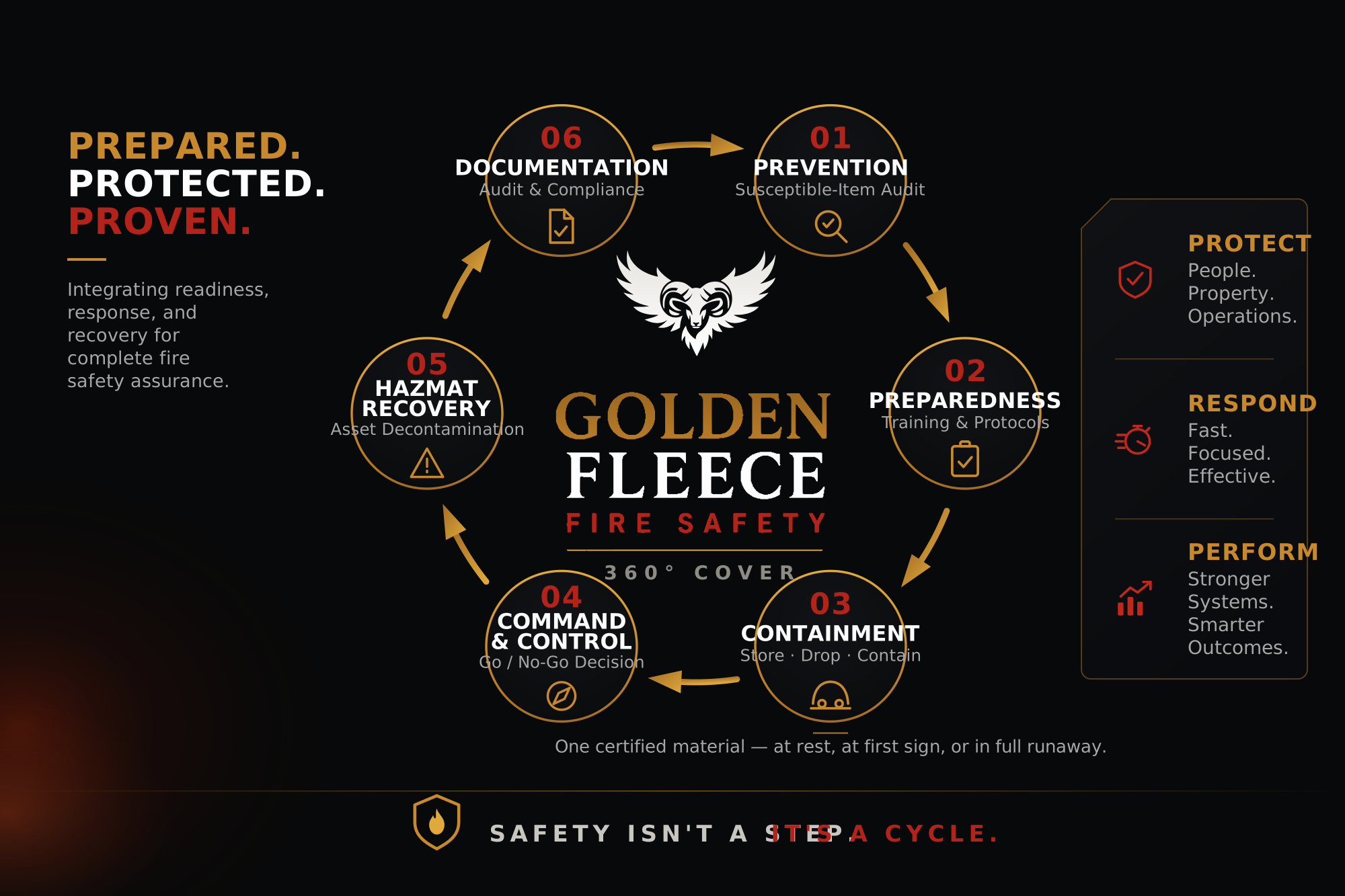
Most providers stop at deployment. Golden Fleece runs the whole loop — from the audit that stops the incident starting, through containment and recovery, to the documentation that proves it.
We stop most of them, and we contain the rest.
Prevention removes the predictable failures — the places where lithium concentrates and a single cell can take the site with it. Containment holds the ones that get through. Nobody who has stood in front of a thermal runaway promises it will never happen; the discipline of the programme is that it plans for both.
Walk the site, map where lithium concentrates, specify the controls — before any of it becomes an incident.
More infoLithium exposure is concentrated, not dispersed. It gathers in predictable places — the charging rack, the tool store, the locker bank, the radio shelf, the row of e-bikes on trickle overnight. Prevention begins by finding them.
A Golden Fleece susceptible-item audit walks the site and maps where cells are stored, charged, and handled — and where a single failure would take the most with it. From that map we specify the controls: segregation, storage, and containment at the point of concentration, matched to the exposure they stand against.
The output is a specified control, not a catalogue. Where the assessment calls for it, that means a defined item — a fire-resistant storage bag for a radio bank, a battery store, a charging-area cover — engineered to its job and documented like every other stage. The item is the deliverable. The assessment is the offer.
Site assessment, written protocols, instructor-led training. Competency frameworks aligned to DIN 91489:2024-11.
More infoEngagement begins with an on-site exposure assessment — where EVs are parked, charged, serviced, and stored, and how the existing emergency response is built around them.
From that baseline we deliver written response protocols, role-specific competency training, and instructor-led drills. All training is documented and traceable to a named individual; all protocols are version-controlled and aligned to DIN 91489:2024-11.
Rapid blanket deployment to isolate the incident, shield infrastructure, and suppress smoke spread.
More infoThe Golden Fleece Containment Blanket is deployed over the incident vehicle within minutes, isolating the thermal event from surrounding infrastructure and substantially limiting smoke and toxic-gas spread.
Containment, not suppression, is the operating model — the blanket is engineered to hold the incident through the full reignition window, not to put it out.
Structured decision-making at each escalation point. Clear authority, clear records.
More infoEvery escalation point has a defined decision-maker, a defined criterion, and a defined record. There is no ambiguity about who calls evacuation, who calls fire-service handover, who calls cordon extension.
This is the difference between a response that survives a coronial inquiry and one that does not.
Controlled removal of contaminated materials. Differentiated handling prevents secondary contamination.
More infoThe fire is the visible event; the contamination is the lasting one. HF-laden runoff, particulate fallout, and the contaminated blanket itself are all hazardous waste — and most operations have no protocol for handling any of them.
Golden Fleece provides the procedure, the documentation chain, and the differentiated handling that prevents the recovery from becoming a second incident.
Audit-grade records supporting regulatory compliance, insurer scrutiny, and post-incident review.
More infoEvery stage above produces a record — site assessment, training register, deployment log, decision audit, recovery manifest. Together they form a defensible evidence chain.
It is what stands up under regulator review, insurance investigation, and — if it ever came to it — coronial scrutiny.
Containment is a moment. Cover is the commitment that keeps the operation protected long after it — recovery, reinstatement, and the documentation to prove it.

You're covered by agreement.
Never left to reorder.
Most EV containment is sold as a one-shot product — deploy it once and it becomes your problem: a contaminated, hazardous item to dispose of, and a gap in protection until you source and specify another. Two costs nobody wants to own.
360° Cover removes both. After a deployment the used unit is recovered and professionally decontaminated at a certified HAZMAT facility, then inspected — repaired and returned to service where it can be, or responsibly retired where it can't. Your protection is reinstated to a defined service level: no gap in cover, and no automatic scrap-and-replace — a full 360° service, start to finish.
Certification frameworks are retrospective by design. They codify what was learned from past incidents — and lithium-ion thermal runaway is still outpacing the standards. DIN 91489:2024-11 is the best available benchmark. It is not the ceiling.
Golden Fleece is certified to every applicable standard. We are not defined by them.
Our outcomes focus drives everything beyond the certificate: the HAZMAT lifecycle, the 72-hour reignition protocol, the cover guarantee, the documentation chain that holds up under coronial scrutiny. None of that is mandated. We built it because the standard doesn't reach far enough — and the gap is where people get hurt.
The mission is to save lives, support first responders, and reduce the financial and environmental consequences of lithium-ion events. Compliance underpins that mission. It does not complete it.
Full certification documentation available on request. See the complete certification detail →
Golden Fleece is a small, deliberate organisation. Every part of the response — the standards, the technology, the training, the documentation — sits with named people who own it.

Les Fletcher's career spans more than thirty years on the front line and at the strategic top of fire safety. He served as a manager with Merseyside Fire & Rescue Service, became Head Fire Safety Trainer at Saudi Aramco — one of the world's largest energy operators — and went on to serve as Fire Chief for NEOM, Saudi Arabia's $500 billion infrastructure megaproject. Along the way he has directly commanded responses to lithium-ion battery failures and thermal-runaway events.
He founded Golden Fleece after seeing the same gap cost operations dearly: too many products are engineered to satisfy paper standards rather than to perform under the stress of a real incident. Existing kit was re-labelled vehicle-fire equipment; existing protocols treated thermal runaway as if it were petrol combustion. So he built a programme that starts from the response and works back to the product.
Day to day, Les leads client engagements personally — every site assessment, every training delivery, and every post-incident review. "Our mission is simple," he says: "combine battle-tested operational command with rigorous certification, so clients get equipment and advice that deliver genuine safety — not just checkbox compliance."

Alan Penton brings the regulatory and legislative depth that sits behind every Golden Fleece recommendation. His career includes serving as the National Fire Chiefs Council (NFCC) sector expert to the Health & Safety Executive, and his in-depth practical experience is supported by leading fire safety compliance in two fire and rescue services.
Alan integrates decades of operational knowledge with a deep understanding of legislation, audit requirements, and best practice in fire and health and safety, underpinned by an MA in Research (University of Liverpool) majoring on risk and decision making.
Alan's role is to ensure that the products and services Golden Fleece delivers are suitable and sufficient for the foreseeable hazards likely to be encountered by organisations.

Randy Narine is President and CEO of Clean Core Research in Canada, our independent testing partner — a ten-year fire-service veteran and lithium-ion battery tester who leads the real-world fire testing and thermal-runaway simulation that independently validates Golden Fleece's performance.
Through Clean Core Research's field investigations, laboratory work, and controlled destructive testing, Randy and his team document the long-term corrosion and contamination that follow lithium-ion thermal runaway — the evidence base that shapes standards, policy, and Golden Fleece's own products.

Dr Xu Dai is our research collaborator at the University of Liverpool's Fire Safety Engineering Group, whose current work includes lithium-ion battery fires — their structural impact, the real-world data behind them, and maritime and car-park incidents. He pairs Golden Fleece's containment work with independent science at a Russell Group university.
Dr Dai is a Lecturer in Structural Engineering and a Royal Academy of Engineering / Leverhulme Trust Research Fellow. His career spans NIST in the United States and Buro Happold, and his structural fire-engineering research informs how thermal-runaway events are understood and specified for — the independent evidence base behind our performance, not self-declared.
More team members will be introduced here as Golden Fleece expands. Every named role will carry its own credentials and accountability.
Golden Fleece is one of four organisations working together to move lithium-ion fire safety forward — pairing frontline response and certified products with world-leading research, independent testing, and certified hazardous-materials recovery. No single discipline solves this; the partnership is how the whole problem gets covered.

A research partnership with the University of Liverpool's Fire Safety Engineering Group, whose current work includes lithium-ion battery fires — their structural impact, the real-world data behind them, and maritime and car-park incidents. Our collaborator there is Dr Xu Dai, Lecturer in Structural Engineering and a Royal Academy of Engineering / Leverhulme Trust Research Fellow, whose career spans NIST in the United States and Buro Happold — pairing our containment work with independent science at a Russell Group university.

Our independent testing partner in Canada, led by Randy Narine. Clean Core Research conducts real-world lithium-ion and EV battery fire testing and thermal-runaway simulation — the independent validation behind our performance, not self-declared.

Our recovery partner, based in Liverpool city centre — a certified HAZMAT decontamination facility. Deployed containment units are professionally decontaminated by The Less Group, then inspected and repaired for reuse or responsibly retired — the circular process behind 360° Cover.
For readers who want the complete picture — the legal foundations, the structural precedents, the documented evidence behind the programme — two short reference pieces.
Three procurement objections. Three legal answers. How the Go / No-Go protocol meets the obligations imposed by the Regulatory Reform (Fire Safety) Order 2005, the Health & Safety at Work Act 1974, and Section 44 of the Employment Rights Act 1996.
Read the frameworkLiverpool Echo Arena, 2017. London Luton Airport, 2023. Two named UK car-park fires, six years apart, both started by a single vehicle, both demolished. The pattern, the economic frame, and the response specifiable today.
Read the caseThe complete certification stack: DIN 91489:2024-11, NFPA 701, CAN/ULC S102, ASTM, SGS, ISO 9001, ISO 14001, CE, UKCA, and recognised industry memberships. Thirteen marks across product standards, independent testing, membership, and quality.
See the detailTell us about your operation, your exposure, and what's in place today. We'll come back with a scoped recommendation — not a sales pitch.